
“State of the Union” 2026
Every year, the President of the European Commission delivers a State of the Union address to the European Parliament. The address is an opportunity to present the vision for the EU's future development, to report on achievements and to announce new initiatives. This year, security and geopolitics were a clear common thread. In addition, Canada was invited as the EU's first "associate member" and the President launched new environmental and climate initiatives.
This year, as last year, there was great excitement surrounding the content of the speech. “If I look at Europe today, my assessment is this: the state of our Union is stronger than it has ever been. At the same time, the state of our Union can also feel more uncertain than ever.” This is how Commission President Ursula von der Leyen began her speech. This year, too, European security and independence were central. The President announced, among other things, that the EU will continue to increase its defense budgets, become less dependent on oil and gas, and step up support for Ukraine.
New European Security Council and associate member
European security was by far the biggest topic in the speech. In addition to continuing sanctions against Russia and strengthening Europe's resilience against Russian aggression, von der Leyen highlighted Greenland and the Arctic as strategically important areas that the EU wants to make its flagship projects. Among the new measures she announced are a new European Security Strategy, a greater focus on hybrid threats through a "Counter Hybrid Playbook" and the establishment of a European Security Council. In this context, Norway, Canada, the United Kingdom and Iceland were also highlighted as desirable partners.
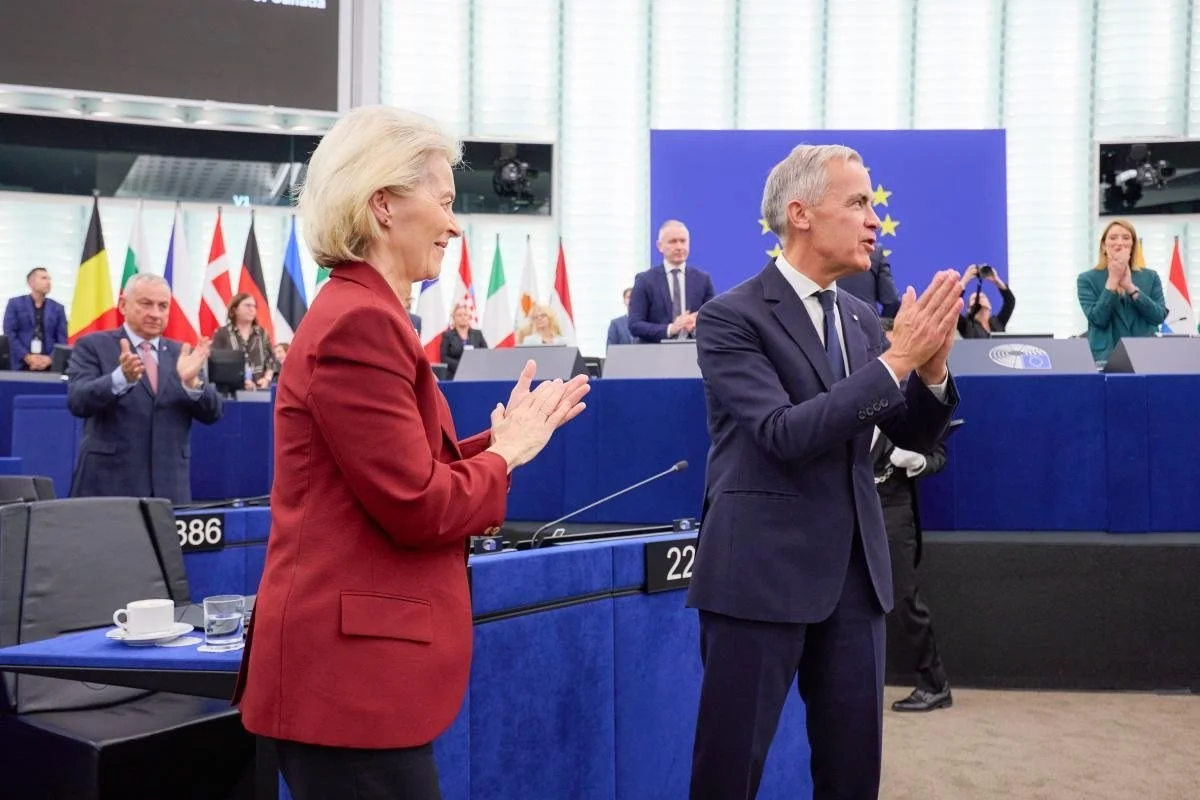
Copyright: Dati Bendo / European Union 2026
During this year's speech, Canadian Prime Minister Mark Carney was invited to Strasbourg. One of the highlights was the Commission President's surprise announcement that Canada is being invited to become the EU's first "associate member". What this new form of association will entail in practice is currently unclear. However, Carney welcomed the offer in a speech to the European Parliament. It will be interesting to follow the further development of what is described as a partnership for shared prosperity and economic security.
Critical raw materials and China
Von der Leyen's top priority is to protect investments and strengthen the European economy. She particularly highlighted the already launched " One Europe, One Market" plan , which aims for the EU to have a more unified internal market by the end of 2027.
This year, there was also great excitement about whether von der Leyen would address the EU's relationship with China in her speech. It turned out that the president took a harder line than expected. She stated that the Union had reached a "tipping point" and called for a rebalancing of trade relations after many years of large trade deficits. One of the most central points is China's dominance of the value chains for critical raw materials.
Environmental and climate initiatives
Before West Norway It will be particularly interesting to follow which climate and environmental initiatives may now be launched. In her speech, von der Leyen announced a new European Water Initiative, highlighting the risks that water scarcity poses to Europe's food security, energy supply and supply chains. According to the Commission, the initiative will contribute to better management of water-related risks, reduce leakages in agriculture and provide farmers and industry with greater predictability.
Von der Leyen also stressed that Europe cannot experience a repeat of this summer's extreme weather events. The European Commission will therefore present a joint plan for dealing with heat waves, with particular emphasis on better early warning and preparedness systems. The President highlighted the need for strengthened climate adaptation, especially to protect the most vulnerable parts of the population.
Industrial capacity and efficiency were also key themes in the speech, closely linked to Europe's future energy supply. Von der Leyen highlighted European green energy as an important tool to reduce energy costs while facilitating further industrial development. "Let's make Europe's future electric," the president said.
New age limit on SoMe
The European Commission is also proposing new age limits for young people's use of social media. Von der Leyen justifies the proposal by saying that parents have increasingly lost control, while pointing to the serious consequences of platforms and apps that are addictive for young users. "This deprives young people of their childhood," says the president. Through what will be called the "EU Kids Act," the Commission is proposing that 13 years of age will be the new absolute age limit for social media, while 15 years of age will be the limit for creating a personal profile. Developments in artificial intelligence are central to the debate about the digital everyday life of children and young people, and AI naturally also had a large place in von der Leyen's speech on Wednesday.
For more details about the speech and the upcoming focus areas of the European Commission, read more here:
State of the Union 2026 – Letter of intent