
By Anna Lygre Solvang
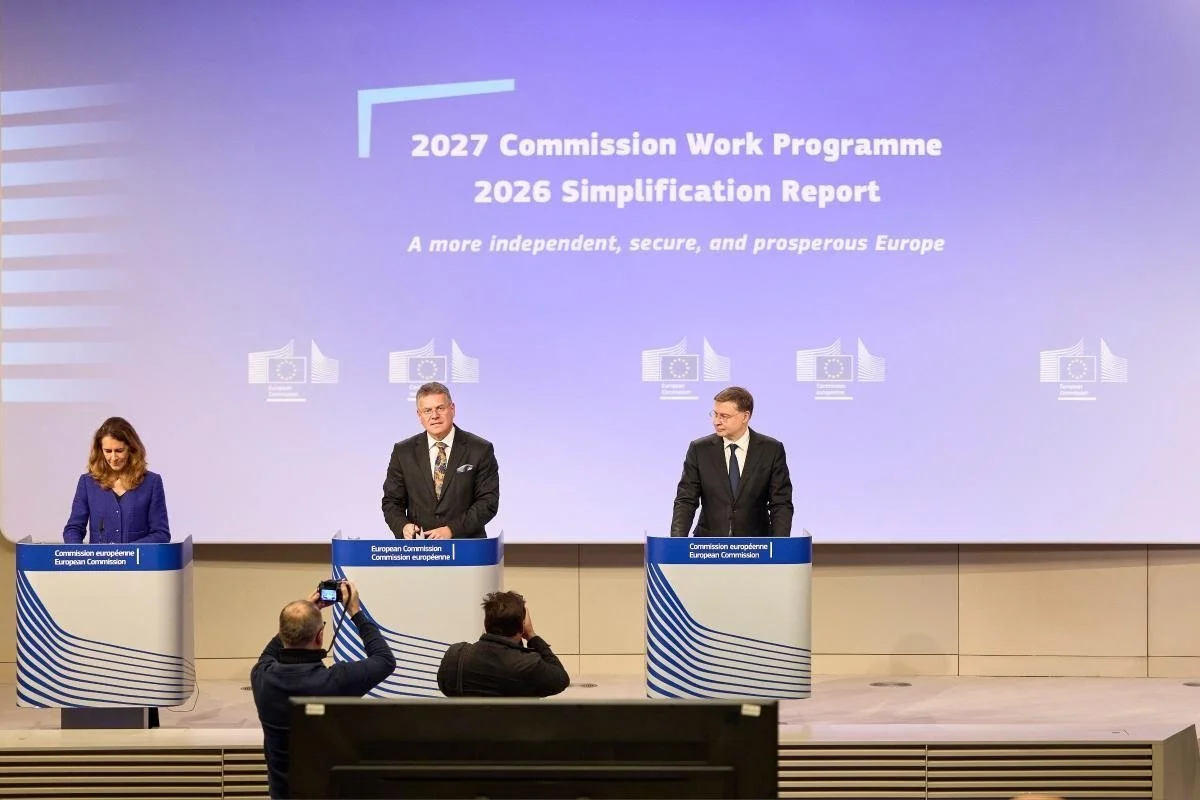
The European Commission's Work Programme for 2027 focuses on European competitiveness, strategic autonomy and security. The slogan of the work programme is "European Union – standing up for one another". The programme reflects the fact that the EU must increasingly secure its own strategic interests in a world characterised by geopolitical unrest, fiercer global competition, high energy prices and rapid technological development.
Every year, the Commission adopts a Work Programme, which outlines the main initiatives to be implemented in the coming year. The Work Programme is an important tool for delivering on the commitments outlined in the Commission's political guidelines and the actions announced in the annual State of the European Union address.
The Work Programme has 23 key initiatives, including 10 simplification measures. The European Commission has already presented 12 simplification packages (omnibus packages) and other simplification measures. When all of these are implemented, the Commission estimates that administrative costs could be reduced by €22.3 billion per year.
We have compiled the most important proposals planned for 2027.
© European Union, 2026, licensed under CC BY 4.0
Lower energy prices, increased energy security and a new framework after 2030
Energy is one of the key areas of the work programme. The Commission will combine short-term measures to reduce energy prices with a longer-term framework for Europe's energy system. The geopolitical situation has highlighted the vulnerability of European supply chains and the importance of access to energy and fuels at competitive prices. The Commission will therefore work on coordinated measures to address high energy prices and secure energy supplies.
A key proposal is the Post-2030 Energy Framework and Simplification Package , planned for the first quarter of 2027. The framework will simplify energy regulations after 2030, while ensuring that the 2040 framework contributes to achieving decarbonisation goals. This means that the EU must find a balance between emission reductions, security of supply and competitiveness.
The Commission will also examine the possibility of a "market mechanism for clean heat". The purpose is, among other things, to stimulate increased use of heat pumps and reduce investment costs for households.
Other energy-related proposals include:
- Evaluation of the temporary crisis framework for state aid for the industrial sectors most exposed to high energy prices.
- Short-term measures to optimize European refineries.
- Proposal to postpone certain obligations under the methane regulation.
Higher education and expertise
European Universities Alliances 2.0
The initiative will build on the experience of the European University Alliances and contribute to high-quality education across borders. The goal is to strengthen cooperation, innovation and Europe's competitiveness. Western Norway University of Applied Sciences is a partner in the European university alliance Artemis , which started in 2025.
European Universities Alliances 2.0 has two main elements:
A proposal for a separate legal status for European university alliances, through changes to the regulations for the European Grouping of Territorial Cooperation (EGTC) . Such a legal status could give the alliances a more permanent institutional basis for cooperation across national systems and regulations.
A non-binding initiative to further develop alliances as a driver for innovation and European competitiveness.
It is expected that these proposals will be presented in the fourth quarter of 2027.
Skills Guarantee
The initiative will facilitate opportunities for workers to develop and retrain. The Commission points in particular to the need to support workers who need to acquire new skills in order to participate in the working world of the future. Measures will also be considered for young people facing challenges related to artificial intelligence and changes in the labour market.
The Skills Guarantee is planned as a non-legislative initiative in the third quarter of 2027.
Safety and preparedness
The work programme signals a clear commitment to security, defence and preparedness. One of the proposals is the establishment of a " European Security Emergency Protocol ". The protocol will enable member states to receive rapid and coordinated European support.
The Commission will also work to further operationalise Article 42.7 of the EU Treaty on collective protection, and explore the possibility of establishing a European Security Council together with the EU's closest partners. This was also mentioned in the State of the Union address of the Commission President earlier this autumn.
Within preparedness, the Commission will also strengthen Europe's ability to deal with natural disasters, extreme weather, forest fires and other crises.
Critical raw materials
Access to critical raw materials is an increasingly important prerequisite for European industry, technological development and defence capabilities. The Commission will establish a " European Corporation on Critical Raw Materials ". The initiative will help secure access to raw materials needed for, among others, electric vehicles, semiconductors, batteries and the defence industry.
The background is Europe's need to reduce strategic dependencies and ensure more robust supply chains. The work is part of a broader ambition to strengthen economic security and industrial capacity.
The Commission has not yet specified a specific quarter for the presentation of the initiative.
Digitization and artificial intelligence
The Commission will review the objectives of the Path to the digital decade and present a broader " Digital Transformation Package " in the second quarter of 2027. The package will modernise and simplify the digital framework so that it is better aligned with technological developments and the needs of European businesses.
An action plan for industrial AI is also planned within five sectors: health, transport, agriculture and food production, advanced industry, and defense and space.
Other selected initiatives:
Long-term budget and new EU programmes : The EU's next long-term budget (Multiannual Financial Framework (MFF)) applies for the period 2028–2034. This is also important for Norway, as the long-term budget will, among other things, finance EU programmes such as Horizon Europe, Erasmus+, the Competitiveness Fund and the EU Civil Protection Mechanism (UCPM).
The design of EU programmes is among the priority initiatives in the work programme. The ambition is for the new EU programmes to be able to start on 1 January 2028. To avoid a funding gap, the Commission believes that it is crucial to reach a political agreement on the MFF by the end of 2026. This will not be easy .
Housing Simplification Package : Building on the Affordable Housing Plan, the Commission will present a Housing Simplification Package in the second quarter of 2027. The aim is to increase the supply of housing by reducing administrative burdens and making it easier to implement construction and renovation projects. The Commission highlights that the housing crisis is not only a social challenge, but also an economic one that affects Europe's competitiveness and ability to attract workers.
Right to Stay : This strategy will identify measures that can help both residents and local communities have better development opportunities, as well as create better framework conditions for settlement.
It is important to clarify that the work programme is not binding, but that it functions as a strategic framework. It provides a preliminary overview of what we can expect in 2027, but the timetable for the various proposals may change. The work programme also provides an overview of pending legislative proposals that will be withdrawn and existing legal acts that will be repealed.
The work programme was launched together with the annual report on the simplification, implementation and enforcement of EU legislation. The report provides a comprehensive overview of progress in the work to simplify EU legislation and ensure more effective results.
Read more:
Commission work program 2027 - annexes
Commission work program 2027 explained - factsheet
2026 annual overview report on simplification, implementation and enforcement